Showing posts with label facebook. Show all posts

Sunday, February 21, 2010

Don't Forget About Blogs

View Comments
With the meteoric rise of social networking sites like Facebook and Twitter, many corporate communications professionals tend to forget about the power of a blog. Blogging started well before Facebook and Twitter were present in the social media landscape so they aren't as flashy or fun these days. Blogs and even blog networks are more dispersed so the traffic numbers don't seem as impressive as social networks.

Facebook can publicly state that it has over 400 million users worldwide and Twitter can claim over 75 million users, but blogs typically define their traffic individually. Gizmodo, a very popular technology and gadget blog can very impressively make the case that they had 1,981,394 unique visitors last month. Though this is amazingly impressive, some markets don't grasp the importance of this number compared to the 400 million total users on Facebook.


A blog offers a concentrated, focused audience. Outreach performed to a blog, or the creation of a blog, can be much more effective than creating a Facebook fan page or Twitter account. A blog has more potential to become a conversation hub, a lasting community and a trusted source than social networking platforms. Blogs allow for more in-depth content because there is greater freedom to write lengthy posts or post a variety of content (text, video, slideshows, streaming video, live blogging plug-ins).

Don't get me wrong, there is immense value in social networks, especially when done well. I just want to make sure that blogs are forgotten in the equation because they may be a brands best option to meet their communications goals.

I know I can think of examples in my professional life where I have suggested a blog to a client, but it was shot down because it didn't have the "potential growth" that Facebook offered.

Do any of you have any examples of blogs being passed over or dismissed as a viable option?
Stumble
Delicious
Technorati
Twitter
Facebook
Read full story

Tuesday, February 16, 2010

Make Your Facebook Fan Page Stand Out

4 comments
Why would a brand or business create a facebook fan page? Most likely they are trying to increase awareness about the brand as a whole or a specific initiative. They may also want to improve brand loyalty and engagement with their target audience. Those are all good reasons to create a fan page, but having a good reason won't actually accomplish those goals.

Brands have to promote their fan pages across a number of platforms to even alert their target audience that the page exists. They also have to provide value or entertainment to the visitors so they continue to come back. It is this latter area where the brand should really work to make its page stand out from the plethora of other brands using a cookie cutter design and content formula for their fan pages.

A brand can either make their page stand out through the content they provide or the design/layout of the page. Each brand will know better than I will what qualifies as unique or valuable to their audience, so I won't even attempt to assert some universal answer that can be applied across all industries and goals.

There are a number of ways to enhance the design of a fan page. A brand shouldn't feel as though they are restricted to the use of fan page standards like a wall, photo sharing tab, video sharing tab, links tab and discussion board. Those are all great features, but brands should go to the next level.

One of the most important features a Facebook fan page offers is "FBML." This is Facebook's version of HTML language and allows users to add components that they might find on other platforms. The FBML feature gives users the freedom to add widgets of all varieties, links and a number of other things. Instead of simply adding links to other relevant pages in the FBML box, it might be nice to add hyperlinked photos using FBML tags so there is a visual association with the link that entices visitors to click through.


There are also a number of previously developed applications that can simply be plugged into a fan page. Brands shouldn't be afraid to browse through these and see if any will help them accomplish their goals while bringing some variety to their fan page.

There are some great Facebook developers and resources out there so if a brand is looking to create a page that is awe-inspiring it can definitely be done.
Stumble
Delicious
Technorati
Twitter
Facebook
Read full story

Tuesday, January 12, 2010

Social Media in an Impoverished Mexican Town

2 comments
I just returned from a vacation in a Akumal, Mexico. Akumal is a small town about one hour south of Cancun that survives almost entirely on eco-tourism. It is a place of great scenic beauty, but tremendous societal shortcomings. The picturesque beaches, caves, rain forests and tropical fish can be overshadowed at times by the meager shacks, lack of sanitary water and high frequency of crime. This was most noticeable on the only main road between Akumal and Cancun. It was on this road that I passed one tourist destination after another all behind great walls that mirror the magnitude of Fenway's "Green Monster" and are designed to keep out the "dangerous locals." Tourists are reminded that there is danger by the teams of security guards armed with semi-automatic machine guns.

Maybe it was because I was re-reading "Groundswell" or maybe it was because I was curious about the digital capacity of a place that had such a sharp contrast bewteen beauty and squalor, but I asked some of the locals about their use of social media. I wasn't surprised to hear that social media is not a commonly used technology in Akumal. When I said the word "Facebook" to a group of four guys it was returned with two confused looks, one indifferent response and one "oooh Facebook, ci." I inquired what that meant and found out that the lone guy in the group that knew Facebook wasn't a member, but had seen adds where brands communicated that they were on the social media platform. They were more concerned about buying their groceries, fixing their palm roofs or paying for a new bicycle tire (their primary method of transporation) than the computer or mobile technological devices it would take to operate social media. There also wasn't much need to connect with the outside world. In Akumal, most communications happen face-to-face and there isn't much need to communicate with people that you wouldn't see in person.

This isn't a grand revelation, nor will it affect marketers in any way. Brands aren't marketing their products to people that can't afford them. This revelation did give me pause to ask "why am I so wrapped up in a technology that only a small percentage of the world can truly use the way it is meant to be used?" Sometimes, in the world of business we move so quickly that we don't stop to think about the big picture. I think it is important to put some perspective in what we do and think about if the people in a place like Akumal, Mexico care about the tasks we devote 50 plus hours a week to.
Stumble
Delicious
Technorati
Twitter
Facebook
Read full story

Thursday, December 31, 2009

Happy New Year!

0 comments


Happy new year everybody! It has been a great decade all around and especially for the growth of social media. We've seen blogs grow exponentially, social networks come into their own, online video and photo sharing sites explode, mobile technology being invented and much, much more.

Have a great time tonight, but beware those texting hands. Try not to use Twitter or Facebook unless you are of sound mind. There are always great examples of what not to do while drinking on textsfromlastnight.com.

Stumble
Delicious
Technorati
Twitter
Facebook
Read full story

Monday, November 9, 2009

My wedding is keeping me from social media

0 comments


I got engaged a couple months ago. I had been dating my then girlfriend for over six years and knew that it was the right time, right place and absolutely right girl. What I didn't fully grasp was how much time and energy planning the wedding would take.

With the time it takes to select a band, narrow down catering options, pick invitations and all the other components I have to cut time spent elsewhere. For me it was a difficult, but also simple choice.

I wasn't going to be able to cut time from work. Social media growth and brand adoption of social media strategies means more work. I can't cut time with family, dogs and friends because they are simply too important to me. I don't want to cut exercise time because it is important for me to be healthy and I have a marathon scheduled for several weeks from now.

This ultimately means that I have to reduce the amount of time I spend with my personal social networks. I spend less time tweeting, on Facebook, writing blog posts, joining in on discussion boards and posting video/photos.

It got me thinking what additional things happen in people's lives would keep them from participating in online communities as much as they would like? Are other people willing to sacrifice time spent doing other activities for the sake of social media?

Stumble
Delicious
Technorati
Twitter
Facebook
Read full story

Tuesday, October 20, 2009

Breaking Down Technorati's 'State of the Blogosphere'

0 comments


This year Technorati has rolled out their "State of the Blogosphere" in a five-part series. They'll be posting one part every day throughout this week. Thus far, they have posted "Who Are the Bloggers?" and "The What and Why of Blogging."

These two parts alone have a host of information to digest, critically analyze and apply to your social media knowledge. In an effort to highlight the most important stuff, I'll be breaking down the info and asking a few questions along the way.

Methodology:

Technorati collected data from Penn, Schoen and Berland Associates who conducted a survey of 2,828 bloggers nationwide. They also gathered data from 11,000 active Lijit publishers (bloggers using the Lijit search widget) and 2.5 million blogs connected by link to these Ligit bloggers. This data collection method is somewhat biased because it takes a certain type of blogger to decide to download a Lijit widget. It becomes immediately less likely that casual bloggers or bloggers who see no value in Lijit can contribute their input to the survey. The correction for this of adding blogs who are linked to Lijit users helps a fair amount but still isn't an entirely valid and random representation of the blogoshpere.

Realisticially, it would be an enormous undertaking to get a representative and random sampling of blogs so I can't complain too much about their choice of blogs.

Major Points:

1. The state of the blogosphere is strong

2. There are 4 types of bloggers

  • Hobbyists: 72%- This group blogs for fun and don't make any money from blogging
  • Part-Timers: 15%- They blog to supplement their income, but don't use blogging as a full-time job
  • Self Employeds: 9%- People who blog full-time for their company or organization
  • Pros: 4%- Also listed as blogging full-time for their company or organization, but apparently don't blog as many hours per week

3. Bloggers are educated and in good standing financially:

  • 1/3 of respondents has a household income of over $75K
  • 75% of bloggers have a college degrees
  • 40% have graduate degrees

4. People who have worked in traditional media are migrating towards blogs. 35% of all respondents have worked within the traditional media as a writer, reporter, producer or something else

5. Bloggers are beginning to use mobile devices to blog, but it is still not a common practice:

6. There is a significant increase in professional blogging. This means blogging for the purpose of gaining income, business connections and increased revenue is on the rise.

7. Blogging has been beneficial to individuals careers and work goals. 58% of respondents said they are better-known in their industry solely because of the blog.

8. The volume of blogging is on the rise. 57% said they plan to blog even more moving forward, which included 74% of 18-24 year olds.

My Observations:

1. The growing number of "professional" bloggers is changing the face of blogging as we have known it for the last 10 years. Technorati asserted that only 36% of of professional bloggers discuss the political and social implications of their topics. The topical and neutral stances of professional bloggers have created a trend of less emotional, opinionated posts, which is what blogging was founded upon. I'm a professional in the social media world so I understand the idea of professional blogging, but I would hate to lose the passion and opinions that blogging is synonymous with.

2. Technorati tried to play to the dichotomy between traditional and social media with survey questions lke "are blogs better written then traditional media?" Bloggers didn't fall into the trap. Based on Technorati's data, bloggers were resistant to the notion that trditional media is either failing or decreasing it's content quality. Its important that a mutual respect remains present between the two parties because as each day passes the lines become more blurred.

3. Technorati found that "30% of those who are blogging less say it's because they are devoting more time to microblogging and social networks." In other words, bloggers are writing less because they are networking and having fun on sites like Twitter and Facebook. This is a very important trend. Does this mean that blogging is on the decline? Are other platforms rising up to destroy the blogosphere? I'm pretty sure the answer is "No." Other platforms are actually being tied into the blogosphere to help promote individual blogs. Twitter and Facebook updates are riddled with links to blog posts. Still, the next wave of technology could make blogging a pastime much in the way of chat rooms.


Technorati has been struggling to regain some of the prominence it once had. This report provides great data for all those marketers and social media junkies out there, but is it enough to bring Technorati to the top again? I guess we will have to wait and see what the next three parts of the report have to say.


Stumble
Delicious
Technorati
Twitter
Facebook
Read full story

Sunday, October 4, 2009

Social Media Manifesto

0 comments


A spectre is changing communication as we know it. All the powers of old media have migrated to the social media because Generation X, Generation Y and Baby Boomers continue to push forward with social media innovations and ardor.

Is there still opposition to the social media revolution or is it accepted that the new communication channel will continue to evolve into the heavily favored method of human interaction? How is social media being used and how will it be used in the future?

This post will illustrate the growing power of social media and the likelihood of this trend to continue.

Size of Social Media:

Top Social Networking Platform:
  • Facebook had over 370 million visitors in the last month
  • Over 160 billion page views
Top Social Bookmarking Platform:
  • Digg had over 23 million visitors in the last month

  • Over 410 million page views
Top Microblogging Platform:
  • Twitter had over 66 million visitors in the last month

  • Over 4 billion page views
Over 184 million blogs have been created worldwide, while 346 million people read blogs worldwide.

The particularly interesting thing is that all of these technologies have continued their growth in recent years. This doesn't mean that a single technology can't die because it can. Myspace was once the largest social networking tools, but the creation of other options has led to a decline in popularity and traffic. When one technology falls another one rises. Out of the slightly burning embers of Myspace grew Facebook. Out of the ashes of chat rooms grew social networks, discussion boards and blogs.

Research, innovations in technology, business trends and the zeitgeist all indicate that social media's size and power will remain on the incline.


Why is Social Media Appealing?

There are a plethora of reasons social media has grown in rapid fashion over the last decade, but most importantly it is because each individual can have a unique experience depending on their habits, strengths and interests.

A user can be extremely active or they can barely participate. It is the users choice whether to be a member of a Ning group, a discussion board, have a Facebook profile, start a Youtube channel or any other number of things. Users can decide whether or not they simple want to view content or whether they want to participant in the creation of content. Users can chose how they want to be known both visually and with respect to their personality. They can alter their user interface as well as their method of communication.

More importantly than all of the use based choices is the ability to become affiliated with whatever community is desired. A user can become a part of a political discussion board, a Boston Red Sox blog, an accountant's Twitter stream, or a single mother's photo sharing community.

In social media, a user is free to affiliate themselves with whomever they wish, whether like minded or not. It is this freedom of expression and acceptance into groups that makes social media so appealing to people. The rules of proximity and status levels dictating personal relationships are thrown out the window with the advent of social media.

Social media can be the digital embodiment of the "American Dream." Anybody can start a blog, work diligently and become a pseudo celebrity/financial success.

Social Media is also appealing to brands and businesses. It presents a new method of communication for brands. Social media:
  • Is a platform that is significantly lower in cost than traditional marketing and public relations platforms

  • Gives brands greater power of messaging control

  • Allows for interactivity with consumers and potential clients, which can increase brand advocacy

  • Provides near real-time metrics for top-line understanding of ROI
Pitfalls of Social Media

To truly immerse oneself in social media is to engage in a shift of paradigm and lifestyle. Social media requires focus, intelligence, innovation and above all else simply being present on a regular basis.

The positive aspects of social media like interactivity, networking and community building come with certain time requirements. If you want to become a prominent figure in a large social media network, it requires an immense amount of time. Not only that, but the hours dedicated must be dispersed throughout the day in an effort to respond to people around the world.

In addition to the time commitments, there are certain privacy concerns that arise when asserting oneself in the social media landscape. More and more technologies offer status updates, photo sharing, video sharing, live streaming video and 24 hour connection through mobile devices. These advances in technology can make it seem as though Big Brother is watching or we are living in an Orwellian reality.

Not only do thoughts, images and locations become public but they remain public. Social media tools are highly advanced at archiving their content. This is done both for the user experience and to provide metrics proving the value of the tool. The potential issue with these archiving systems is that what a user says publicly now remains public forever. User's opinions may change, they may be caught in a photo that they wish not be shown or any other number of of examples, but ultimately the universal archival of content can pose real problems for some users.

The Future of Social Media

If nothing else, social media has proved to be unpredictable. The ability to truly predict what technologies become popular, what videos become viral and how much people will value the ability to share their opinion in a public forum is difficult to determine. A few trends have emerged that should continue based on human nature and social media culture:
  • Social media will become more manageable. There is already a trend to combine multiple social media platforms in a single interface like Tweetdeck or Google Wave, but the variety of platforms means a need for an all-inclusive management system.

  • Brands and marketers will continue to find ways to automate their social media communications initiatives. Whether consumers agree with this tactic or not, developers will create tools that they can sell to businesses, who will in turn use them to streamline the outreach process.

  • Business and organizations will implement more restrictions. Social media policies are a highly discussed topic amongst anybody dealing with brand reputation. There are a number of social media policies in place and made public. This will undoubtedly continue as social media evolves.

  • There will be an increase in group and community development. Social media users are now finding that a path to social media happiness or success can be best achieved by uniting with others. Groups like SB Nation, eMarketing association and wefollow tags are prime examples of people uniting to bolster their own efforts while connecting with interested/interesting people.

Stumble
Delicious
Technorati
Twitter
Facebook
Read full story

Thursday, September 24, 2009

Are There Any Professions That Shouldn't Adopt Social Meida?

0 comments


Earlier this year we heard from CNN and other media outlets that surgeons were tweeting from the operating room. Surgeons decided to use Twitter to inform a larger community about the details of certain procedures and the safety precautions that are taken.

Though I find a play-by-play of a surgery extremely interesting, I would be livid if I woke up to find out that my surgeon was distracted by Twitter, Facebook updates or any other social media platform. I've been through a couple major surgeries in my life. I wasn't at all nervous for them, but that was because I knew my surgeon would be focused entirely on me.

I spend my life educating people about the pros of social media. Sometimes I get so wrapped up in talking about the positive impact social media can have on life, marketing campaigns, awarness and more that I neglect to share that social media isn't for everybody.

In the example above I don't think tweeting during surgery is a good fit, but I would encourage the hospital to create a Twitter account and share details about it's staff and procedures.

What do you think, are there any professions that shouldn't be adopting social media for one reason or another? Police? Teachers? IRS auditors?...
Stumble
Delicious
Technorati
Twitter
Facebook
Read full story

Tuesday, September 22, 2009

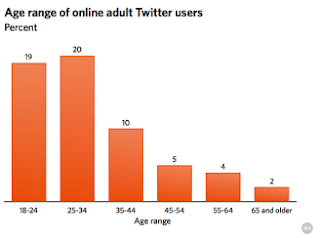
Twitter Trends Younger

0 comments


The Pew Internet and American Life Project asserted in a recent study that Twitter has younger users than the rest of the internet. In fact, 40% of Twitter users are under the age of 18 and 59% are under 24.

This is especially big news when we consider that Facebook is trending older. It is obviously important for markets and public relations professionals to know which demographics are populating which social media platforms, but it is also important for the users. If a 16-year-old is deciding whether to sign up for Facebook or Twitter, knowledge of these statistics might factor into his/her decision.

Pew also found:

"The use of Twitter is highly intertwined with the use of other social media; both blogging and social network use increase the likelihood than an individual also uses Twitter. Twitter users and status updaters are also a mobile bunch; as a group they are much more likely to be using wireless technologies -- laptops, handhelds and cell phones -- for internet access, or cell phones for text messaging. "

This is a fact that can't be ingnored. Many Twitter users have cross-polinated themselves across the social media landscape. Twitter is a great community to be a part of if it fits your goals, but you can still interact with many Twitter users on various other platforms.

Though Twitter is popular, it certainly isn't the end-all-be-all of social media.

Stumble
Delicious
Technorati
Twitter
Facebook
Read full story

Friday, September 18, 2009

Incorporating Social Media Into Internal Communications

8 comments


Internal communications are an integral part of the efficiency of a large or small company. Internal communications can include e-mail, an intranet, office newsletters and much more. The wave of social media has brought with it a host of tools specifically designed for internal communications.

One of the most popular social media tools for internal communications purposes is Yammer. Yammer is essentially Twitter for the office. The benefit of Yammer is that it's a private communications channel for employees to share quick messages about what they're working on, get questions answered or blast out news. According to the site, Xerox and Cisco are among the over 200-plus companies using the service.


Robert Scoble recently wrote in his e-book "The Conversational Corporation" that Accenture has an internal community that looks a lot like Facebook, except that its private. Rather than talk about personal stories and opinions, the employees use it to discuss business related subjects and share eachothers experiences and knowledge.

If the top companies are incorporating social media tools into their internal communications, don't you think other companies should evaluate if it is a good fit for them as well?
Stumble
Delicious
Technorati
Twitter
Facebook
Read full story

Saturday, September 5, 2009

What if Twitter fails?!?

0 comments


I was recently speaking on a social media panel in Georgia. The room was filled with marketers from large brands like Napa Auto Parts, Coca Cola, Best Western and Aarons. Even though these were marketers, they almost all fell closer to social media novices on the spectrum.

As is usually the case when speaking with people that aren't extremely knowledgeable about social media, the conversation became focused on the most popular tools and in particular Twitter and Facebook.

After discussing the benefits of these technologies to the marketing process, a very fair question was asked...

"What if Twitter fails?"

It really is a great question. Brands have a legitimate concern of a social media platform like Twitter going under after they spend significant time and resources building of a valueable presence.

The core of the answer is very simple: SOCIAL MEDIA IS ABOUT RELATIONSHIPS WITH PEOPLE

If marketers approach this communication realm in that way, they will be able to transfer the conversations they're having on Twitter to any other social media platform when needed. If people/consumers trust you, enjoy your content and feel like they are a part of something real they will follow the conversation from Twitter to Facebook to Ning to a discussion board on the brand website. It is truly about the strength of the relationship with readers and consumers.

While building a community on a specific platform, be sure to cross-polinate your messaging on at least 2-3 platforms total. For instance, if your primary communication spot is Twitter you may also want to have a Facebook fan page and a blog. Send your followers to all of these locations throughout your entire communication process. This will train your readers to visit your other platforms if one of these technologies fail overnight.
Stumble
Delicious
Technorati
Twitter
Facebook
Read full story

Monday, August 3, 2009

Social Media Is About Individuality

0 comments


When trying to market your brand and increase communications through social media, you have to remember that each person and each community is unique.

Social media communications can't be mass produced. Every social media technology has a plethora communities within it. All of these communities have their own interests, ways of sharing opinions, languages and code of ethics. Within that, the individuals of the communities have to be treated as such. Sure, you can send a message to a blog, discussion board, Facebook group and get some pick-up or engagement, but your brand with grow much stronger and with greater affinity if you seek out individuals or go through the community administrators who are trusted by the community. The notion that your brand is connecting on a one-one level with consumers will hopefully spread like wildfire.

The key in social media is to be human, show some personality and ultimately so your brand is tangible rather than mechanical. You have to remember that no matter how easy it is, mass communication techniques are often tabbed as spam in the social media world.
Stumble
Delicious
Technorati
Twitter
Facebook
Read full story

Wednesday, July 29, 2009

Social Media Strategies Aren't Uniform

0 comments


I had yet another conversation today where I heard a statement like "shouldn't we be building out or Facebook page? I know one of our competitors has a big Facebook presence." This type of statement should sound of an alarm in your social media mind.

Every time I hear something like this I want to yell, "YOU HAVE TO DO WHAT IS RIGHT FOR YOU!" Social media isn't about doing what works for other people or brands, its about finding the right communication strategy for your specific goals and resources. Listening to best practices is good because it will provide you a road map and ideas to discuss, but ultimately you should determine a completely unique strategy.

Some factors to weigh while determining you social media strategy include:
  • Products and Services offered
  • Target Audience
  • Resources
  • Man power
  • Goals (whether to mass message or engage highly active individuals)
  • Personalities of people communicating on your brand's behalf
A brand shouldn't just jump onto Twitter because they think they're supposed to. Again, each brand/individual is different and your social media strategy has to reflect that.
Stumble
Delicious
Technorati
Twitter
Facebook
Read full story

Tuesday, July 28, 2009

Funny Social Media Videos

0 comments


There are thousands of videos out there about social media, some very serious and some very funny. If you interested in learning about social media through video the resources are definitely available, but here are a couple of the more comedic videos about social media for your viewing pleasure.


Stumble
Delicious
Technorati
Twitter
Facebook
Read full story

Tuesday, July 21, 2009

Step by Step Social Media Guide for Brands

0 comments
Most brands and companies have at least dipped their feet in the waters of social media at this point, but if they haven't it can be daunting for them to start. First, social media is confusing for those that aren't intimately involved in it. There are thousands of communication platforms, a set of new languages and some technical skills required. Second, the brands that aren't using social media are behind the curve and therefore might feel like they can't catch up.

There is no doubt that your brand's social media experience should be completely unique. It should depend on your service/produce, your audience, your goals, your budget and many other variables. With that said, this list is meant to provide a general guideline on what needs to be done to truly leverage social media:

1. Monitor And Listen

This is a vital step. You have to listen to your communities of interest. You need to figure out what they're saying about you and your competitors, as well as determining where they are saying it. Is there a large contingency on Facebook, or is the bulk of you audience congregating on Ning? Are they on 7 different platforms?

Listening can be time consuming or costly (depending on your choice of monitoring method), but as I said before it is vital. Monitoring enables your brand to go straight into a strategy with insight and intelligence. It removes a large part of the guess and check of social media.

If you have no budget, you can start with Google alerts about key terms. If you have a budget their are great monitoring tools out there ranging in price from a few dollars a month to a few thousand dollars a month. The price range is affected by the level of insight you are getting from the monitoring company. If you're looking into hiring a monitoring company or licensing their program, I highly recommend one that provides both quantitative and qualitative insights.

2. Develop A Strategy


Now that you know what your target audience is saying and where they are saying, it is time to put a plan in place. Do you want to build a Twitter account, create a blog, comment on popular sites in existence? These are all questions you have to ask.

In addition to the action items, it must be determined who will be doing the social media work internally. It is pointless and potentially harmful to create social media landing pages and profiles for your brand if the content and engagement isn't going to continue. You should figure out ahead of time who will be in charge of the accounts and consumer interactions moving forward.

3. Construct Your Landing Pages

Now it is time to take action. You've done your due diligence, you've decided on the plan and who will be in charge, it is time to set up your landing page(s) and/or profiles. Most social media platforms are pretty easy to set up. This is even more true of social networks like Facebook, MySpace, Twitter and several others. Video/photo sharing channels, Ning accounts, discussion board account, and social bookmarking accounts are also easy to create. Blogs are a little more difficult. The most basic blogs are fairly easy on blogger, wordpress and typepad. If you want to get creative with your blog you might want to seek the help of a knowledgable source.

4. Establish Your Social Media Point Of View

Okay so you have the landing pages or profiles. Now yo have to put up content. Whether is is a blog post, a tweet or something else, you have to produce regular content. This will prove to your audience that you're there to stay, while showing them what value they will be getting from you.

5. Network And Engage

After you've posted content regularly for some time, you need to network with people in your audience. Reach out to the most influential people, share your posts with other sites in your industry and register your Twitter account or blog on directory sites.

It is also key to engage your audience through these communication channels. Ask them questions, respond to inquiries, talk about the things they post about and anything else that might fit.
__________________________________

This is just a basic layout. If you want to get a little more detailed or have critiques of this social media to-do list please reach out and let me know.
Stumble
Delicious
Technorati
Twitter
Facebook
Read full story

Saturday, July 18, 2009

You Forgot Blogs, Discussion Boards, Video Sharing and Others

0 comments


I just came across an article on the Examiner.com asserting that Twitter, Facebook and LinkedIn is the holy trinity of social media. There is no doubt that these these tools are immensely popular and extremely effective marketing tools, but it is terribly shortsighted to call them the holy trinity.

The first segment of social media that was forgotten would be blogs. I know I've lumped hundreds of millions of sites in together here, but that is what blogging is all about. It is having a singular source to share your thoughts, while connecting with others blogs to network and converse. The power of blogs is amazing. Lets look at Gawker Media Groups blogs in particular:

  • Gizmodo averages over 2 million visits per day
  • Lifehacker averages over 1 million visits per day
  • Deadspin averages just under .5 million visits per day
Those are astounding numbers that cannot be discounted when weighing the value and influence of a social media tool.

Discussion boards are still wildly popular. They are most prevalent when talking about consumer products or college athletics, but lets not forgot about the passion that is shown on these forums. The fervor people display in these forums is greater than you will ever see on a social network or a comment section of a blog.

Video and photo sharing sites also can't be forgotten. The Youtubes and Flickrs of the world have immense influence and often touch the peripheral social media users more than other sites will. These are also rapidly growing platforms and will continue to gain strength moving forward.

I don't want to call out the writer of this original statement, but I think he jumped the gun on declaring the existence of a holy trinity of social media.
Stumble
Delicious
Technorati
Twitter
Facebook
Read full story

Friday, July 17, 2009

Can Social Media Do It Alone?

0 comments


Social media as been proven to be a great marketing tool, but can it be relied upon as a stand alone marketing strategy? Clearly with a question like this, I'm going to have to start with the obligatory "it depends." The size of the company/individual/brand, the scope of their campaign and the target audience are all variables that need to be weighed.

With that said, I think the most common answer is NO. Social media should not be used as a solo marketing strategy. It is best used when integrated into a multi-platform marketing plan. This means incorporating traditional media and advertising, maybe including a mass e-mail push and other common components used by corporate America over the years.

Don't get me wrong, there are certainly examples of social media being successful on its own. One of the most commonly used examples comes from Hewlett Packard and Buzz Corps:
  • In early 2008 HP launched a new laptop they dubbed 'The Dragon'
  • HP employed traditional advertising methods initially
  • Sales fell flat
  • With Buzz Corps, they created a competition administered through 31 specially identified techie blogs
  • Sales of the Dragon subsequently increase 84%
  • HPShopping.com experience a traffic increase of 14%
  • Google searches for "31 Days of the Dragon" exceeded 380,000
  • Estimated reach/impressions from the campaign approached 49 million
  • Check here for more
Though these success stories do exists, they are often the exception to the norm. Even companies built around social media like Zappos have a major traditional media and advertising component to their marketing strategy.

Even though there are 200 million plus people on Facebook, over 100 million blogs and Twitter is growing at an amazingly rapid rate, a large segment of the population still visits social media sites in light doses if at all. In order to truly reach the bulk of your target audience, you should actively market on as many platforms as make sense for you particular campaign.

Don't rely on social media to be your lighting in a bottle.
Stumble
Delicious
Technorati
Twitter
Facebook
Read full story

Who? Why?

Social media often becomes a rat race. Who has the newest technology? Who has the most friends or followers? This blog is designed to slow it down a little and remind people that at its core, social media is about relationships and conversations.

Jake Rosen
Managing Supervisor, Fleishman-Hillard
jake.a.rosen@gmail.com

The content on this site reflects my own opinions and not necessarily those of my employer.

Labels

Blogumulus by Roy Tanck and Amanda Fazani

Random Post

Twitter Updates

    follow me on Twitter
     

    Social Media Munchies. Copyright 2008 All Rights Reserved Revolution Two Church theme by Brian Gardner Converted into Blogger Template by Bloganol dot com